How to Build a Team — and Avoid Fighting Over Code

A strong team can solve large-scale and complex problems that are extremely difficult to handle alone. That’s why, in Future Makers: Junior Cup, we strongly recommend participating as a team.
So how do you build one?
Who’s Who in a Team?
British psychologist Meredith Belbin identified nine key team roles .
They fall into three groups:
- roles focused on thinking (intellectual tasks),
- roles focused on doing (action),
- roles focused on communication.
Each role has its own strengths and weaknesses. That’s why tasks should be distributed in a way that allows everyone’s strengths to shine — while minimizing the impact of weaknesses on the overall project. 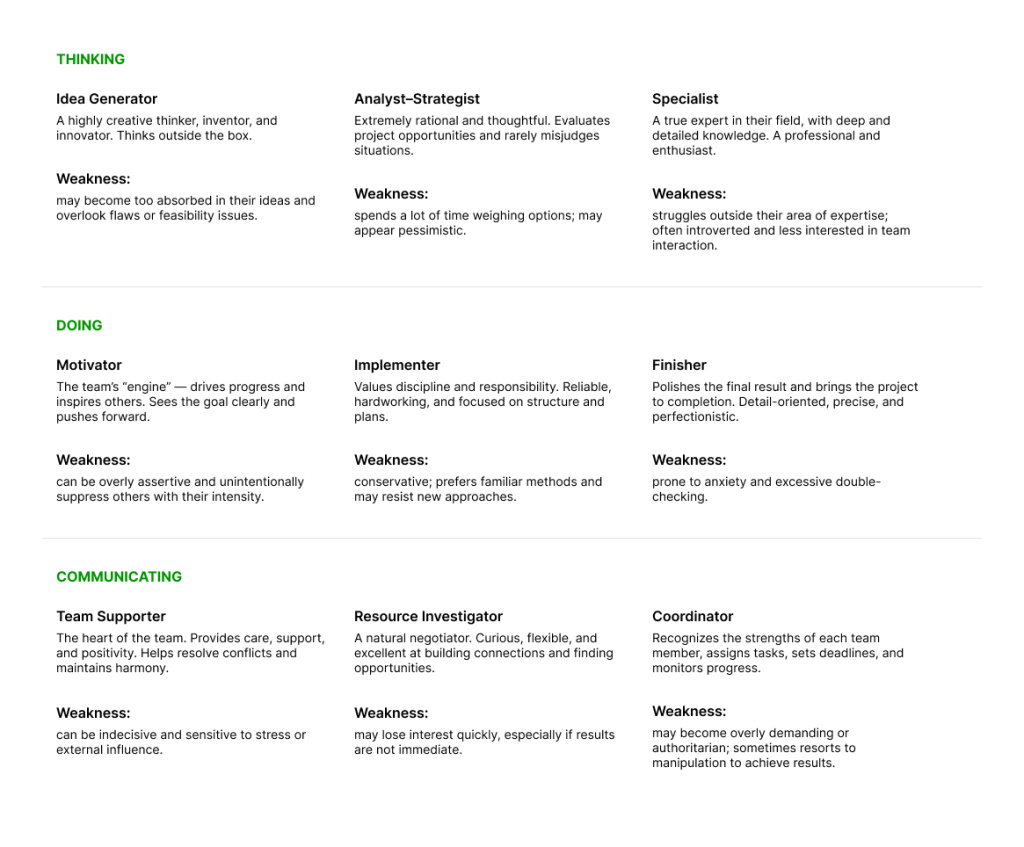
In a strong and effective team, different roles complement one another.
When this balance exists, the team works like a single mechanism: no duplicated efforts, no unnecessary internal competition.
For example:
- the Idea Generator develops solutions,
- the Analyst highlights risks and weaknesses,
- the Implementer turns ideas into action,
- the Coordinator ensures deadlines and requirements are met.
What Can Cause a Team to Fall Apart?
Without shared rules and agreements, chaos can quickly take over — and no coordinator can manage that.
Team rules don’t have to be complicated. What matters is that they apply to everyone.
Examples of simple but effective rules:
- Hold a weekly team meeting to track progress and stay aligned.
- Write a short summary after each meeting, clearly assigning responsibilities — to avoid misunderstandings like “I thought someone else was doing it.”
- Always copy relevant teammates on emails to ensure transparency.
- Communicate delays honestly and early, instead of waiting until the last minute.
- Stay polite, optimistic, and respectful — don’t criticize others for mistakes.
Is a Good Team a Perfect Team?
- no personal attacks,
- everyone has the right to speak without fear of ridicule.

