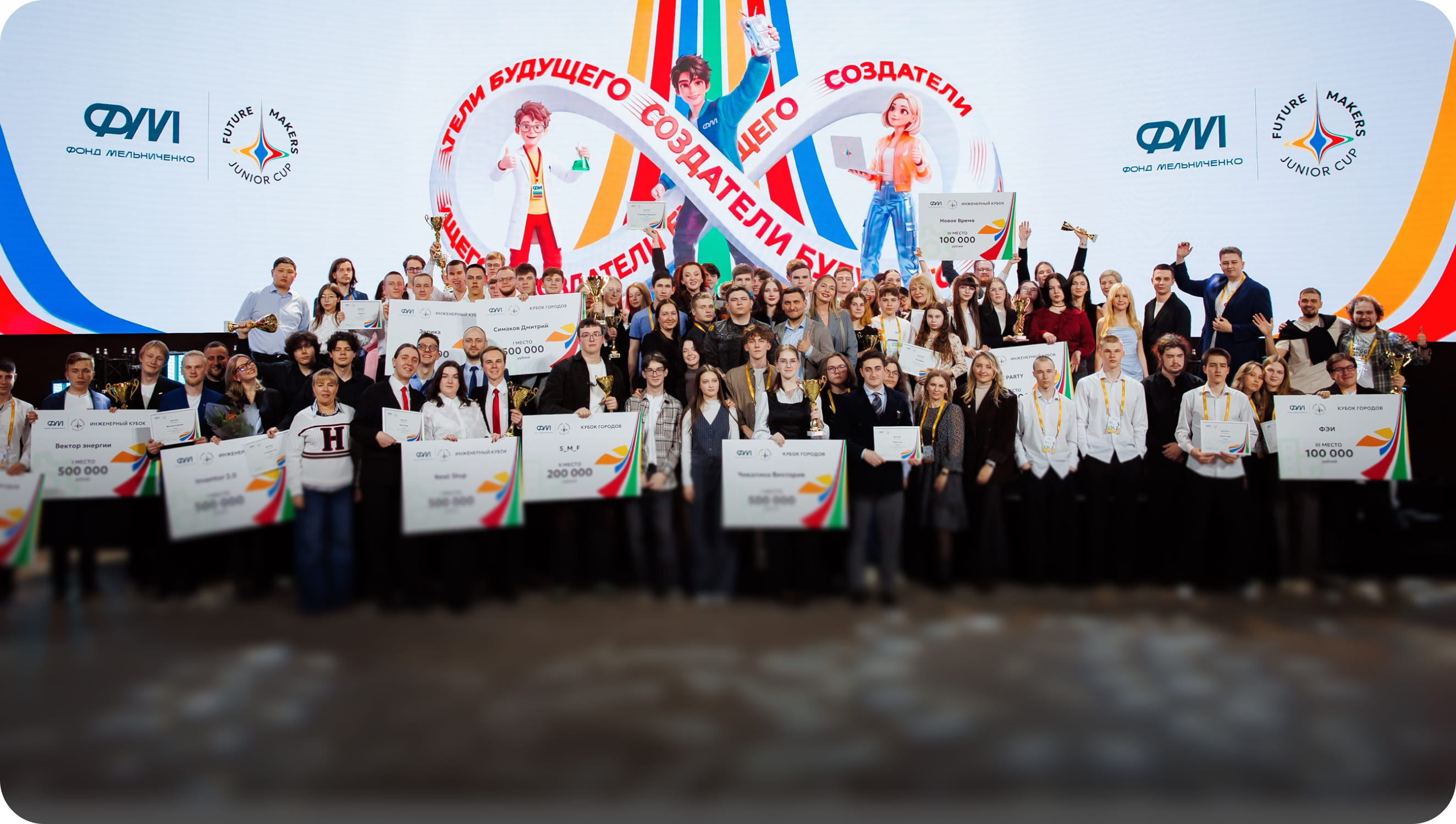


Take part in an international competition of project solutions for real-world industrial and urban challenges Future Makers
The competition features two categories: "Engineering Cup" and "Cities Cup". Each category includes thematic challenges — real-world cases that require innovative, creative, and practical technical solutions.
Future
Makers
Who can participate?
Students in grades 5–11 who are citizens of the Russian Federation and currently enrolled in general education programs (primary and secondary education) at the time of application.
1st- to 4th-year students of secondary vocational education institutions at the time of application who are citizens of the Russian Federation or citizens of countries specified in the Competition Regulations.
1st- to 6th-year undergraduate, specialist, and foundational higher education students, as well as Master's and PhD/postgraduate students up to 25 years old (inclusive) at the time of application, who are citizens of the Russian Federation or citizens of eligible countries specified in the Competition Regulations.
"Start" Category
An employee hired for the first time in their field of study or profession who meets all of the following criteria:
- Aged 18–25;
- Hired within 2 years of graduation;
- Has 1 to 3 years of continuous employment at a single company or enterprise;
- Is a citizen of the Russian Federation or a country listed in Appendix No. 9 to these Regulations.
Additional criteria (which do not override the core criteria of the "Start" category):
- An employee who was an enterprise-sponsored student and was employed during internships throughout their studies;
- An employee who is currently enrolled as a student in a dual work-study program under employer sponsorship;
- An employee with prior non-specialized work experience during their degree studies (e.g., service industry, sales) before joining the company;
- A non-technical graduate (e.g., economics, logistics) hired into corporate functional divisions within their area of specialization.
"Growth" Category
An employee hired in their field of study or profession who meets all of the following criteria:
- Aged 26–35;
- Has 1 to 3 years of continuous employment at a single company or enterprise;
- Is a citizen of the Russian Federation or a country specified in the Competition Regulations.
Additional criteria (which do not override the core criteria of the "Growth" category):
- An employee who was an enterprise-sponsored student and was employed during internships throughout their studies;
- An employee who is currently enrolled as a student in a dual work-study program under employer sponsorship;
- An employee with prior non-specialized work experience during their degree studies (e.g., service industry, sales) before joining the company;
- A non-technical graduate (e.g., economics, logistics) hired into corporate functional divisions within their area of specialization.
Competition Timeline
Regulations document
• Select a challenge from one of the two categories based on your interests • Submit a preliminary application • Start gathering information, conducting analysis, and formulating your hypothesis for solving the chosen challenge
Once verified, your application will be sent to the expert jury. In each category and age group, the jury will evaluate the submitted projects and determine the finalists (winners of the qualifying stage), who will advance to the final round.
Competition categories

Questions and answers
All competition challenges are provided by the Organizing Committee and belong to one of the two categories: Engineering Cup or Cities Cup.
- For the Engineering Cup, challenges are proposed by technical directors and chief engineers of Russia’s leading industrial enterprises — partners of the Foundation.
- For the Cit Cup, challenges are developed by municipal administrations in the regions where the Foundation’s partners operate.
Start by working on one of the proposed tasks, either solo or in a team. This stage helps you explore best practices, generate solution ideas, and outline your approach. At Project School, we’ll guide you in polishing your solution into a clear project application with a presentation ready for the jury.
We recommend inviting experienced mentors — such as teachers or academic advisors — to join your team. Mentors can guide you through the problem-solving process and help you refine your project.
So don’t hesitate to involve teachers!
Review the tasks carefully. Can you handle data collection, analysis, solution design, calculations, and presentation on your own? Identify your strengths and the skills you might need from others. Teams can have up to 5 members, including one mentor.
Create a project plan outlining what needs to be done and setting the deadlines. By the start of the Project School (December 1), you should already have selected your challenge and begun working on it. If you prefer to work independently (without joining the Project School), make sure your plan includes all key stages: research, data collection, calculations, and description of your proposed solution. Consult your mentor when needed. Distribute roles within the team and set 2–3 progress checkpoints and deadlines. By February 1, your team should have a completed project application and a presentation describing your solution.
We welcome participants from grade 5 school students to postgraduate students (up to age 25 at the time of application). Teams may include students starting from grade 5.
The Final Round will take place in Moscow. Exact dates and venue details will be announced in early March. Travel expenses for finalists and their mentors will be covered by the competition organizers.
Use textbooks, research papers, expert articles, and online analytics. There are plenty of free resources. Occasionally, we can provide clarifications through our Competition Partners.
Don’t worry if you’ve never presented before! Finalists will attend workshops to learn how to speak confidently and present effectively in front of the jury.
No, each participant may only join one team.
Potentially yes, but we do not recommend this format. If you reach the finals, you would need to leave the team and participate only as an individual.
Participation is allowed only for one task. Competing individually and as part of a team is also not allowed, even if the challenges are different.
Challenges are not reserved for a specific team or participant. Several participants or teams can work on the same task, which adds to the competitive nature of the competition.
Creating a Minimal Viable Product (MVP) is optional. The further you develop your solution, the higher your chances of success. If an MVP is feasible, try building and testing it—but a clear project plan and presentation are sufficient.
News
See all
Future Makers: Junior Cup 2026 Final — How It Happened

How to Prepare for Your Project Defense at the Final: A Prize Winner’s Experience

Future Makers: Junior Cup 2026 — Qualifying Stage Results
Partners




Information about the Organizer
in engineering and urban development and contributes to the growth of industrial cities and regions.